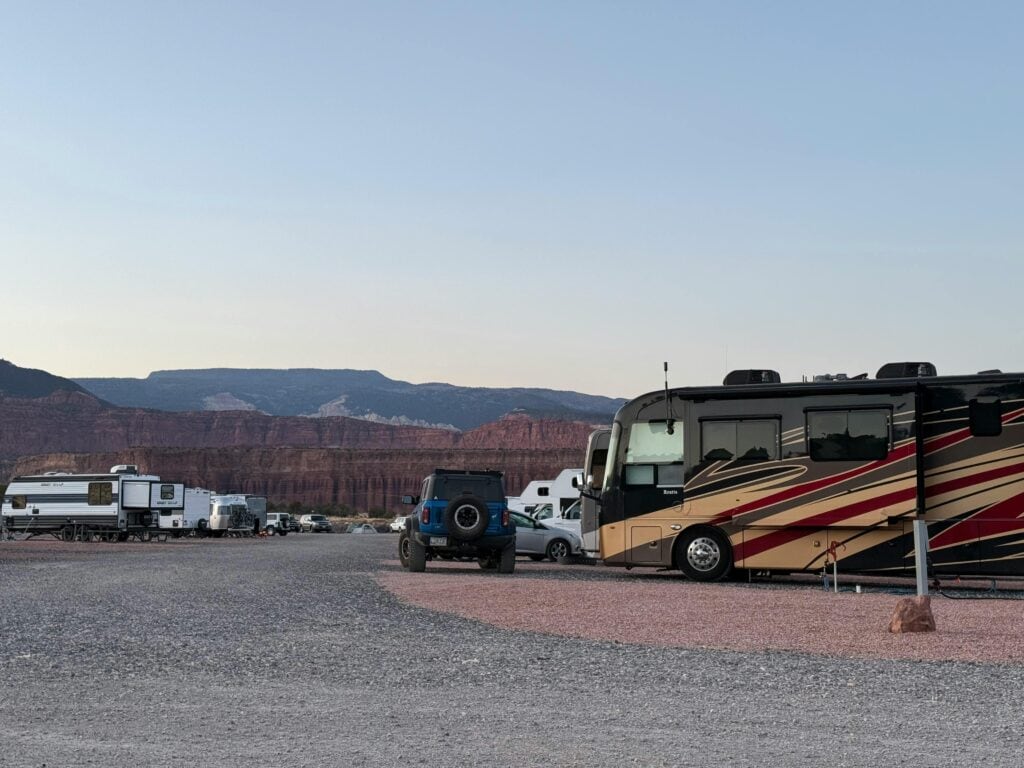
Before you book an RV park, it is imperative that you ask the site a few questions. A two-minute call or email can save you from a surprise at check-in. Here’s exactly what to ask when booking an RV stay!
Why a Quick Call Before Booking Pays Off
Online listings are built to look good, not to answer every question you actually have. A short call or email closes those gaps fast. Most parks are used to fielding these questions and will answer plainly, since a well-informed guest is an easier guest to host. Treat the call as part of your trip planning, not an inconvenience, and you will arrive with far fewer surprises.
Site-Specific Questions
The site length listed online is often the pad’s total length, not the usable length after accounting for a picnic table, fire ring, or sloped ground. Ask directly what length your rig and any towed vehicle will actually fit, including slide-out clearance on both sides. If you are hauling a longer fifth wheel or have an awning that extends past your rig’s length, mention that too.
It also helps to ask about the site surface and levelness. Gravel, grass, and paved pads all handle differently in wet weather, and a site that looks flat in a photo can still need blocks. If you have a specific rig length or turning radius that has caused problems before, describe it to the park directly rather than assuming your situation is typical.
Hookup and Utility Questions
Full hookups usually mean water, sewer, and electric, but the specifics of that “full” vary by park. Ask whether the electrical service is 30-amp, 50-amp, or both, since running two AC units on a 30-amp circuit can quickly trip a breaker. If you rely on a particular amp service for medical equipment or appliances, confirm it is available at your specific site, not just at the park in general.
Sewer and water access deserve the same scrutiny. Some parks offer sewer service only in certain loops, while others require a portable tank or a scheduled pump-out service. Ask about water pressure too, since older parks sometimes have lower pressure that affects showers and tank fills. A pressure regulator you packed for one park may not be necessary or sufficient at another.
Fee and Policy Questions
Extra fees are common in this industry and are not inherently a red flag. Many parks charge separately for additional vehicles, pets, extra guests, or higher electric usage during peak seasons, and these costs reflect real expenses on the park’s side. The goal in asking is not to challenge the fee; it is simply to know your full cost before you arrive, rather than discovering it on your final bill.
Cancellation policies vary just as widely, from full refunds with 48 hours’ notice to non-refundable deposits during high season. Ask what happens if you need to shorten your stay once you have already checked in, since that policy is sometimes different from the booking cancellation policy. If you are booking during a holiday week or a regional event, ask whether minimum-night stays or non-refundable deposits apply, since parks often tighten these rules during high-demand periods.
Amenity and Access Questions
Guest and visitor policies matter if anyone outside your traveling party plans to stop by. Some parks allow day visitors without issue; others require advance notice or charge a visitor fee; and a few restrict visitor access entirely during certain seasons. Ask before you invite anyone, rather than after they arrive at the gate.
Access details matter just as much once you are settled in. Ask about quiet hours, pet policies, and any breed or size restrictions, and whether laundry, showers, or other shared amenities are coin-operated, included, or seasonal. If you are arriving after the office closes, ask specifically how late check-in works, since some parks use a phone code or marked envelope system that you will want to know about in advance.
What’s the One Question Most People Forget to Ask?
Most RVers ask about hookups and fees, but far fewer ask about big-rig accessibility, specifically the turning radius at the entrance and any internal roads. A park can have spacious sites and still be difficult to reach if the access road has a tight turn or a low-hanging branch that was never a problem for shorter rigs.
Ask the park directly whether they regularly host rigs of your length, and whether there is anything about the entrance or internal roads that catches people off guard. Parks that host big rigs often know exactly which turn or tree gives drivers trouble, and a thirty-second answer to this question can prevent a genuinely stressful arrival.
Your RV Park Booking Checklist
Save or print this list before your next call:
- Site length (usable, not advertised) and surface type
- Amp service available (30-amp, 50-amp, or both) at your specific site
- Sewer and water hookup details, including pressure
- Full list of fees beyond the nightly rate
- Cancellation policy, including early checkout
- Guest and visitor policy
- Pet policy and any restrictions
- Quiet hours and shared amenity access
- Late check-in process
- Big-rig accessibility and any tricky turns or low clearance
Book with Town & Country RV Park Today!
Town & Country RV Park sits in Bridge City, Texas — less than 3 miles from the Orange County Advanced Power Station and within a 20-minute drive of every major refinery and LNG facility in the Golden Triangle. Our sites come with all utilities included and free WiFi, so you can park, plug in, and get to work. Book with us today!
FAQ
Should I always call instead of booking online?
Calling is not required, but it is worth it for any park you have not stayed at before. A quick call lets you ask follow-up questions in real time, which an online booking form cannot do.
What’s a reasonable cancellation policy?
Policies vary by season and park size, so there is no single standard. The important thing is knowing the policy before you book, not whether it matches another park’s terms.
Are utility fees typical?
Yes, many parks charge separately for electric usage above a set threshold or for additional vehicles and guests. This is standard practice and reflects real costs on the park’s end.
How do I know if a park is big-rig friendly?
Ask directly about turning radius, internal road width, and whether they regularly host rigs of your length. A park that hosts big rigs often will say so without hesitation.